


Dutch Pavilion, 18th Venice Architecture Biennale
Year
2023
Location
Venice
Commissioned by
Aric Chen, Nieuwe Instituut
Curator
Jan Jongert, Superuse
Architecture can be seen as an articulation of systems – economic, social, political – that shape the built environment and organise and regulate flows of people, activities, resources and ecologies. Often based on extraction and exploitation, these systems seem so thoroughly entrenched as to appear immutable. But in order to move towards a more sustainable, regenerative and just future, many of these systems will need to be rethought.

Plumbing the System
Responding to the Biennales theme ‘Laboratory of the Future’, the 2023’s Dutch Pavilion served as a platform for exploring the potential of future-oriented, regenerative economies and circular design, but with a twist.
The Dutch Pavilion has shown how alternative systems can contribute to a more sustainable future on a macro scale, while attempting to enact (and test) real changes on a micro scale – offering a site where global thinking and local action can meet.

The Waterworks of Money
On the one hand, the pavilion presented ‘The Waterworks of Money’, a series of drawings by cartographer Carlijn Kingma that intricately translates our complex money system into a spatial environment using water as a metaphor. By mapping the flows of money through society, Kingma illustrates the workings of our financial system and its deeply embedded mechanisms that can both hinder and enable change. Kingma has collaborated with leading thinkers in economics to develop and illustrate tangible alternatives or ‘road maps’ that can lead to a more socially and ecologically regenerative economy.

“These times inspire architects and planners to build with a positive impact on their surroundings. To achieve this, they re-evaluate and redirect scarce resources such as water to contribute to the ecosystem. This regenerative practise necessitates a radical change in the economic paradigm that governs the flow of resources today.” — Jan Jongert


By treating water and money as both real and metaphorical concepts, Jongert and Kingma map the ebbs and flows of these resources through micro and macro systems.


“We all know we are living in a time of great challenges that demands changes to how we do things. It’s also a time when there’s no shortage of ideas and propositions for doing so. […] It’s about shifting from words to actions, to help set the wheels of change in motion or, at the very least, to demonstrably show what needs to change in order for change to happen.” — Aric Chen
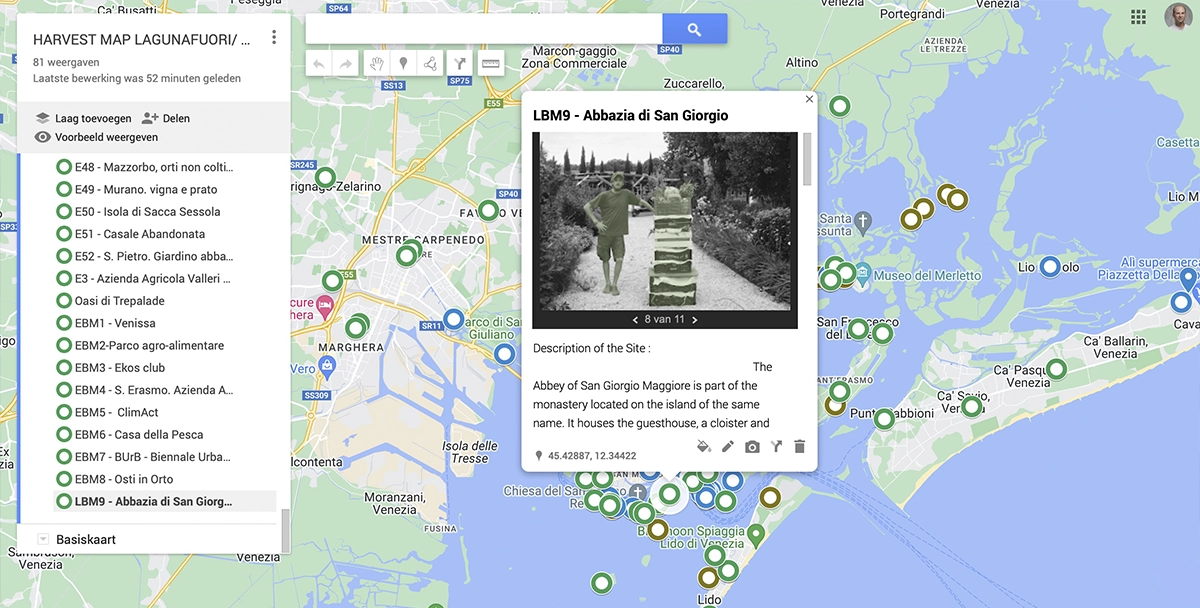
Laguna Fuori / Plumbing the Lagoon
As a third component of the Dutch contribution, curator Jan Jongert initiated research to harvest the potential of a positive metabolism on the regional scale of the Venice lagoon.
The lagoons ecosystem has been under great threat from increased industrialisation, tourism and the changing climatic circumstances. The Biennales temporary activity peaks have contributed to this dynamic in the past.
In collaboration with Venice University IAUV and research and design group Temporiuso, Superuse has conducted a one-week workshop with students of architecture. They identified and mapped the potential resources and actors that can help the transition to a positive dynamic, benefiting from the Biennales taking place.
The results include a digital map and first potential interventions for Living, Work and Food. They were presented to current commissioners, curators and representatives of promising initiatives from Venice. In the coming months, the summary will be introduced to those commissioners cooperating as the Green Lions in Venice, contributing to the legacy of the 18th Biennale.
Project Credits
Curator
Jan Jongert
Project lead
Francien van Westrenen (Nieuwe Instituut)
Program management
Ellen Zoete (Nieuwe Instituut)
Spatial design
Superuse with Iris de Kievith, Sarah van der Giesen and Yannick Verweij
Graphic design
Atelier Roosje Klap
Production
Charly Blödel
On-site production
Bouwko Landstra & team and Valentina Cella
Exhibitors
Carlijn Kingma with Martijn Jeroen van der Linden and Thomas Bollen
Water systems research
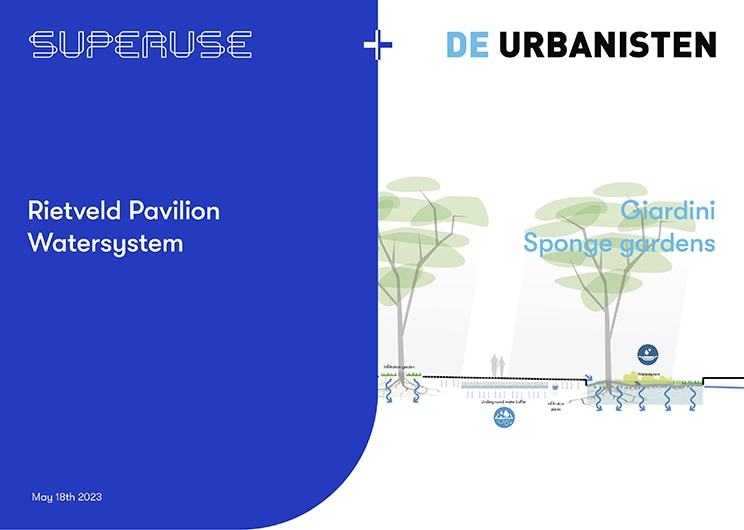
Superuse Studios & De Urbanisten in collaboration with Frank Feder and Geyu Wu
Photography
Cristiano Corte
The workshop ‘Plumbing the Laguna’
Coordinated by Temporiuso: Giulia Cantaluppi, Isabella Inti and Basel Rihani
Supported by ConstructLab: Peter Zuiderwijk and Alexander Roemer
Hosted by Università IUAV di Venezia: Luca Velo and Ca’Buccari: Muck Petzet and Erica Overmeer
The exhibition is supported by the Dutch Ministry of Education, Culture and Science
The project has been developed in collaboration with Wavin & De Urbanisten